Spacecraft and Mission Design
Deep space exploration employs high unit value, often one-of-a-kind, spacecraft intended for purposes and destinations for which humankind has never before aimed. Missions to explore the solar system, and beyond it, involve a lengthy cruise phase which dormant electronics and mechanisms must survive. Following cruise (and perhaps a landing), the vast distances over which flight system health status data must travel, and over which commands must return, mean that much spacecraft fault correction (and science data gathering) must be performed autonomously by flight software. After achieving a landing or an orbit around a distant body, “one-shot” mechanisms, such as single-use deployment devices, must actuate with precision and high reliability.
The risks inherent in such spacecraft design challenges are exacerbated by the extreme environments deep space systems must endure. These include:
-
launch dynamics, including shock and vibroacoustics, and arcing from launch-induced static charge
-
low or zero gravity
-
vacuum or low pressure
-
cosmic (x-ray and gamma ray) radiation
-
a single energetic particle causing a single event effect (SEE)
-
proton or ion-induced effects like displacement damage, latchup, and single event transients (SET)
-
spacecraft surface charging & internal electrostatic discharge
-
total ionizing dose effects from solar energetic particle events
-
temperature extremes
-
hypersonic descent
-
deployment re-contact
-
gravitational variations
-
radio frequency breakdown at low pressure
-
dynamic shock from touchdown
-
contamination from off-gassing, magnetics, or dust
-
damage induced by mechanical wear or by terrain
-
micrometeoroid impacts and space debris
-
thermal cycling
-
one-way light time (OWLI) commanding delays
-
and other, yet-unknown, hazards.
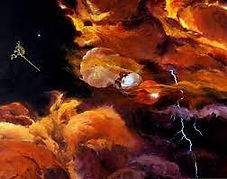
Hence, space systems experience degradation, and they exhibit failure modes, that are uncommon in terrestrial systems that operate in an office or factory environment. The conditions encountered by the Galileo Jupiter probe, including 350 gravities of deceleration and a heatshield protecting the electronics that reached three times the temperature of the surface of the sun, are not factored into system designs intended for Earth use— or even for Earth orbiting satellites.
JPL's Galileo Probe encounters
the Jovian atmosphere
Some of the techniques used to mitigate the high risk of mission failure include incorporating redundant hardware that is fault-tolerant, subjecting the designs to extensive analysis and testing, and compliance with rigorous design principles and spaceflight project practices (e.g., quality assurance monitoring). But relatively few specialists possess the expertise to develop (i.e., design and test) and operate deep space robotic craft. And as funding for space science waxes and wanes, so does access to this expertise, meaning that NASA must to a greater or lesser extent turn to contractors to plug in the missing capabilities. Deep Space Engineering Technology® has an in-depth understanding of the spacecraft design process— and of how systems can fail to perform their intended functions as they encounter the hazards of deep space exploration.